Why a Room Feels ‘Finished’ - and Why it's Usually the Rug
There’s a moment in every room when it just clicks.
The furniture is in place. The colours feel right. The lighting is soft. And suddenly, the space feels calm, considered, and complete.
But interestingly, that feeling doesn’t always come from the big pieces.
More often than not, it comes from what’s underfoot.

What makes a room feel “finished”?
It’s a question we hear (and think about) a lot.
A finished room isn’t necessarily full - it’s balanced. Everything relates to something else. Nothing feels like it’s floating or out of place.
Without that sense of connection, even a beautiful room can feel slightly unresolved.
And this is where handmade rugs quietly do their best work.
The rug as an anchor
One of the simplest ways to understand a rug’s role is this: it anchors a room.
It brings furniture together into a cohesive whole, rather than leaving each piece to stand alone.
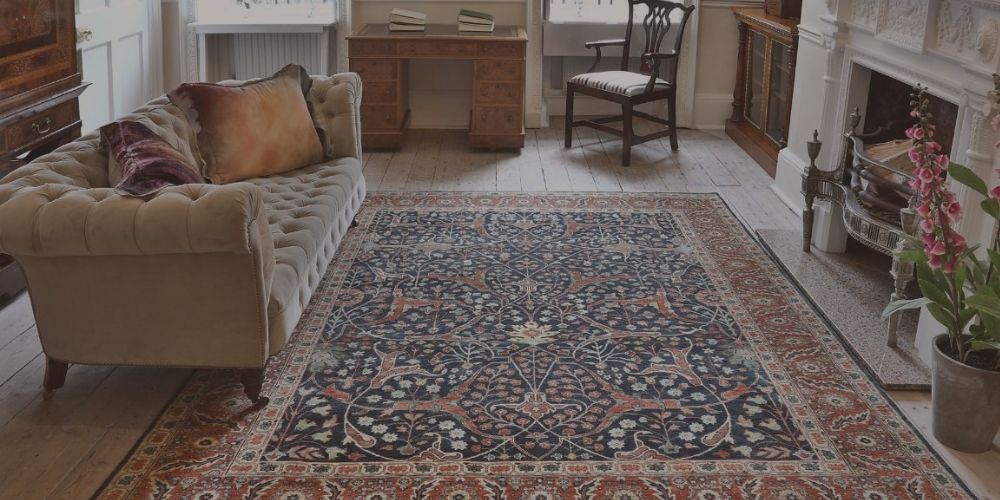
- A sofa and chairs become a seating area
- A table and chairs become a dining space
- A bed and bedside tables become a considered arrangement
Without a rug, these elements can feel disconnected — even if everything else is right.

It softens more than just the floor
A rug doesn’t just add texture underfoot - it softens the entire room.
Hard surfaces (wood floors, stone, large pieces of furniture) can create a slightly stark feel. A rug introduces warmth, both visually and physically.
It absorbs sound.
It adds depth.
It makes a space feel lived-in, rather than staged.
This is often the difference between a room that looks good in a photograph and one that feels good to be in.

Colour, pattern, and quiet cohesion
A well-chosen rug doesn’t have to dominate a space - in fact, often the opposite.
It can quietly tie together colours that already exist in the room:
- Picking up tones from upholstery or cushions
- Echoing natural materials like wood and linen
- Introducing subtle pattern that adds interest without overwhelming
It becomes the thread that runs through everything else.

Why handmade rugs make the difference
There’s something about handmade rugs that makes this effect even more pronounced.
The natural fibres, slight irregularities, and depth of colour all contribute to a softer, more layered feel.
They don’t sit on top of a room - they settle into it.
Over time, they wear in gently, becoming part of the space rather than something separate from it.
This is why they often feel so “right” in a room, even when you can’t quite put your finger on why.
The missing piece (that’s often overlooked)
It’s surprisingly common to see a room that’s nearly there - beautiful furniture, lovely colours - but something still feels slightly unfinished.
Very often, it’s simply missing a rug.
Not as an afterthought, but as the piece that brings everything together.

When a room feels calm, comfortable and complete, it’s rarely by accident.
It’s the result of layers working together - and the rug is often the layer that makes everything else make sense.

Written by Alex Rees